
An AI-powered Help Desk for customer service offers faster, more accurate, and personalized responses to both internal company users and customers, covering customer needs and improving the user experience.
This is made possible thanks, for example, to AI chatbots, expressly trained to provide answers to customers through different AI Agents.
In addition, it lightens the workload for support agents, as AI allows for resolving the most common inquiries, allowing them to focus on higher-value tasks.
Table of Contents
What Problems Do Companies Face in Customer Service Today?
Currently, users expect fast customer service, consistent and capable of resolving their requests autonomously, without the need to contact an agent. However, many companies still manage support with manual processes or without leveraging AI chatbots and other AI tools that allow automating and streamlining incident resolution.
This lack of agility in customer service leads to saturated support teams resolving simple incidents, inconsistent response times, and an uneven experience for both customers and internal users. When information is scattered and not centralized, for example in Help Desk software, duplications are generated, making it difficult to offer a homogeneous service.
Furthermore, the absence of real-time data on the volume and type of requests prevents identifying patterns, anticipating problems, and continuously improving customer service, something that today is only possible through the strategic use of AI tools.
Customers expect fast and autonomous customer service, but many companies still work with manual processes and without AI chatbots or AI tools. This generates saturated teams, inconsistent responses, and little visibility to continuously improve customer service.
How Does an AI Help Desk Software Improve Customer Service?
An AI Help Desk softwareimproves customer service by offering immediate responses through functionalities such as the AI chatbot, the self-service portal, or a corporate chat, a way to offer immediate responses to customer support requests.
Artificial Intelligence allows for analyzing incoming requests, categorizing them automatically, and facilitating faster and more consistent responses to users or customers, even answering in the customer’s own language, always training them with proprietary documentation such as service guides, proprietary URLs, or support ticket histories.
Thanks to AI, support ceases to be reactive to become a more proactive and efficient service.
Benefits of Using an AI Help Desk Software
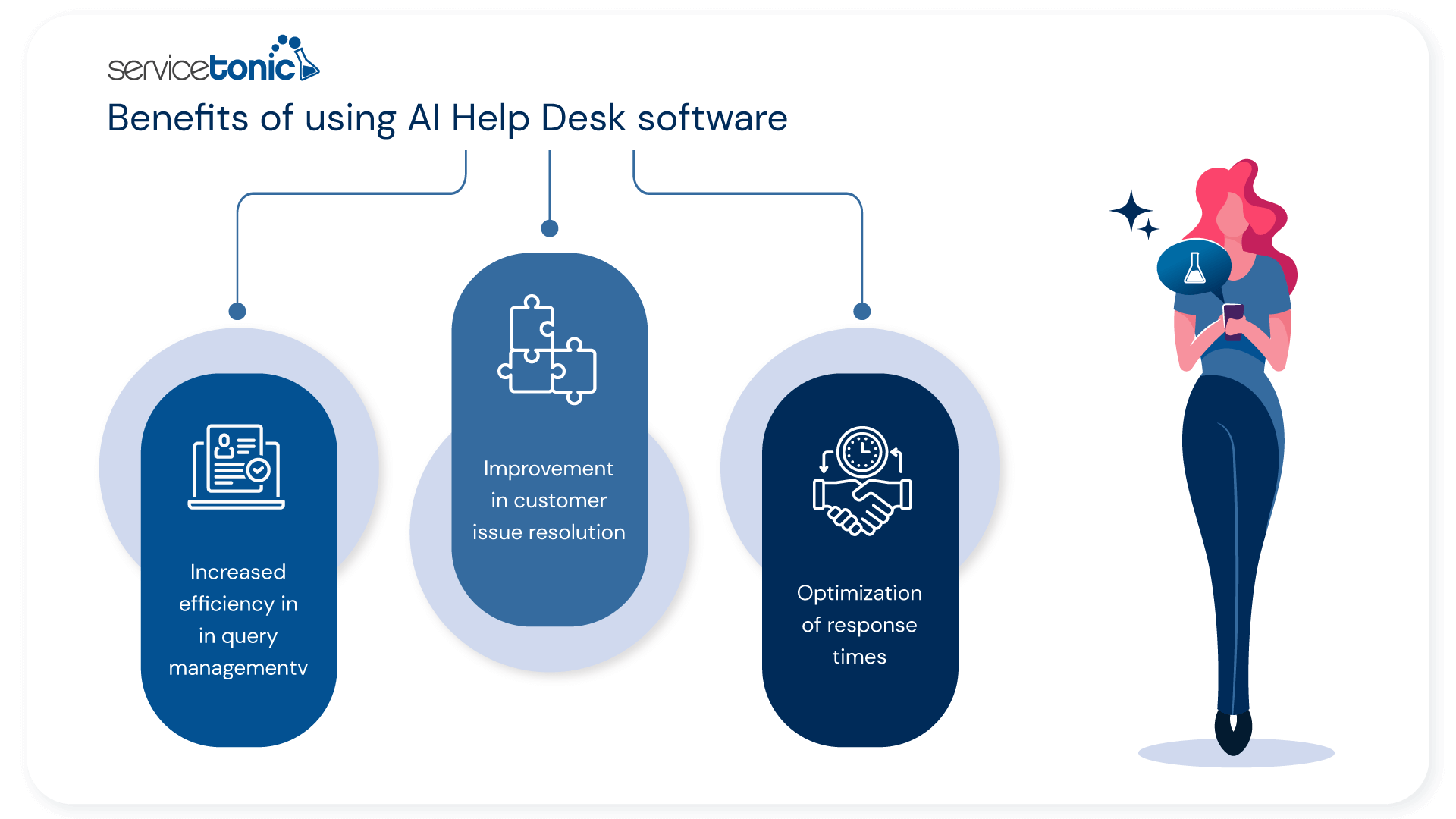
Among the main benefits are:
Greater Efficiency in Inquiry Management
The AI Help Desk software allows customers to get fast and immediate answers to their inquiries thanks to its connection with the Knowledge Base and advanced functionalities such as chat and chatbot, reducing incident or inquiry resolution time and improving team productivity.
By training the AI with resources such as relevant URLs, internal documentation, or ticket history, the system is capable of offering precise and personalized solutions at any time, guaranteeing continuous service, regardless of the time of day or day of the week.
Additionally, with the automation of ticket categories from the Self-Service Portal, together with ServiceTonic’s business rules, it is possible to assign the ticket to one person responsible or another, thus streamlining its management.
Improvement in Customer Problem Resolution
With Copilot AI, agents can significantly improve customer service, reducing response times and offering more precise and better-written answers. Furthermore, this tool allows attending to requests in the customer’s language, ensuring fluid communication and more personalized and efficient customer service.
Optimization of Response Times
Customers can get fast answers to their inquiries in different ways. On the one hand, through chat or chatbot, where AI Agents provide immediate answers to the most frequently asked questions, thus preventing new tickets from being generated and freeing agents from repetitive tasks.
On the other hand, through the use of Copilot AI in ticket management, agents can obtain answers to requests quickly, thus streamlining the response time given to the customer.
AI Applied to Customer Service with ServiceTonic
The key functionalities that turn Help Desk software into Intelligent Help Desk Software are:
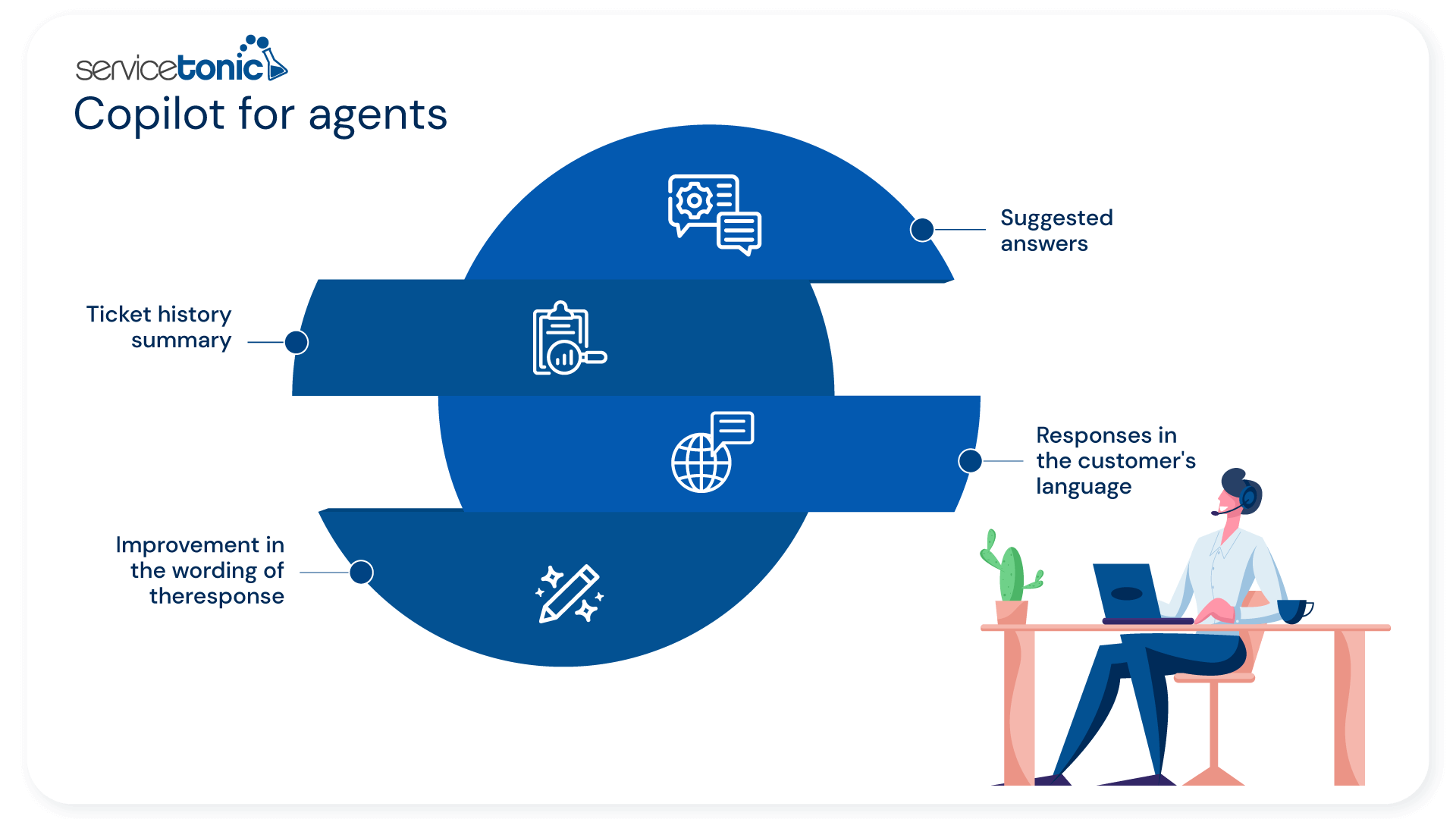
Copilot for Agents
Copilot offers help to agents when answering customer requests in the ticketing system.
Copilot allows:
- Response suggestion: Consults the Knowledge Base, URLs, and documentation that agents have provided, and of course, the ticket history, thus analyzing if that query has been made previously and searching for its answer to offer it again.
- Ticket history summary: Allows summarizing the entire ticket history, thus preventing the agent from losing relevant information.
- Answers in the customer’s language: In a world where companies offer their products and services globally, communicating with customers in their own language has become an essential factor for improving customer service. The ability to offer multilingual support not only facilitates communication but also reinforces trust, closeness, and the perceived quality of the service.
- Improvement in response wording: Copilot AI assists the agent in writing their responses, adjusting the tone of communication—more or less formal as necessary—and automatically correcting spelling or grammatical errors, which contributes to offering a more professional and consistent customer service.
Copilot empowers your agents, it does not replace them.
AI Agents for Customers
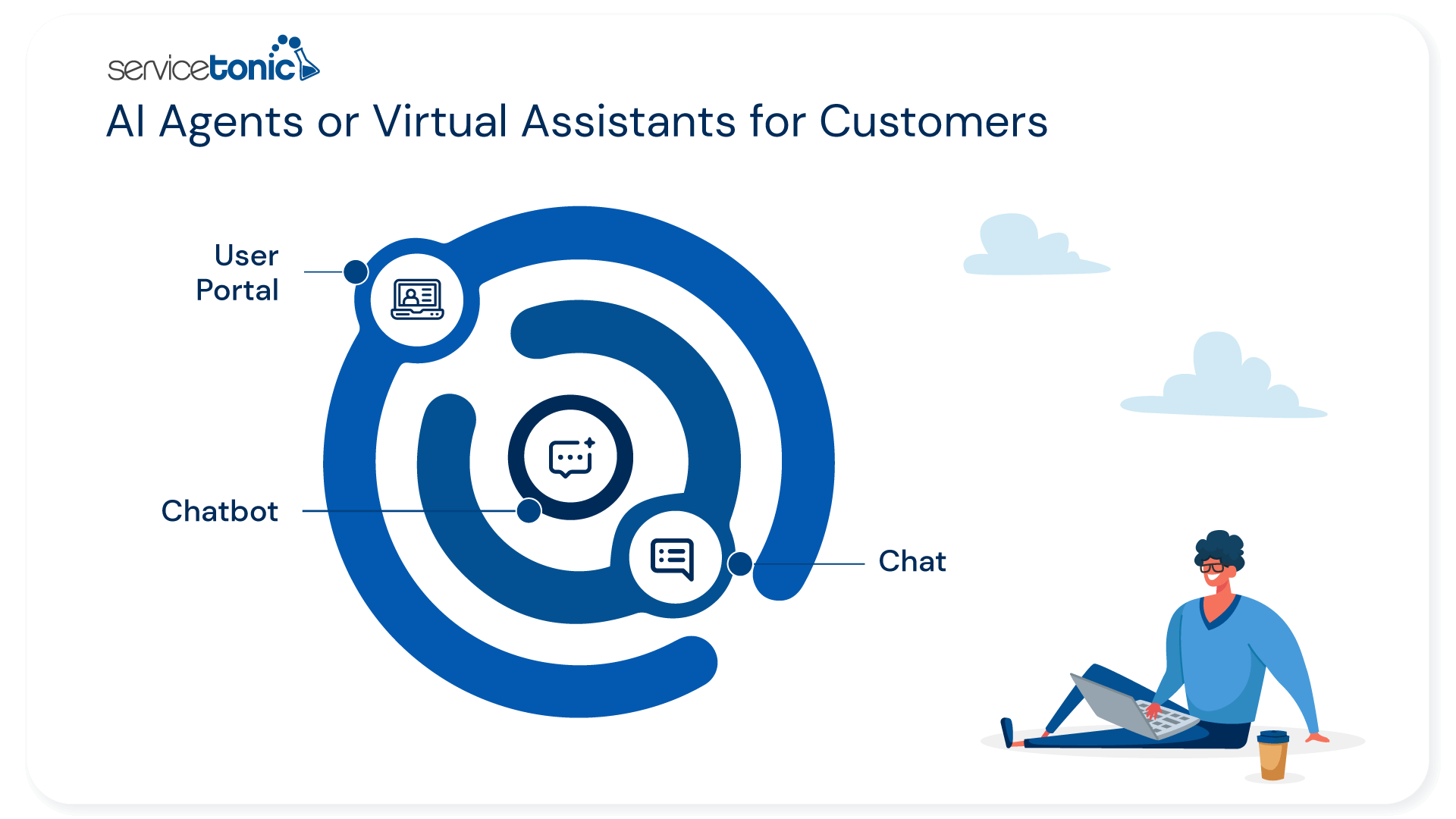
Virtual Assistants or AI Agents can improve customer service through 3 functionalities:
- User Portal: Through the User Portal, customers can open inquiries and communicate with a Virtual Assistant trained by agents with internal documentation, the Knowledge Base, and ticket history. The customer can resolve their doubts directly or decide to open an already categorized ticket, which makes it easier for the agent to offer a more precise and personalized response.
- Chat: The chat, integrated into the corporate website and powered by AI Agents, allows customers to make inquiries at any time. Thanks to AI training, answers are generated in real-time, reducing the need to open tickets. Additionally, a human agent can intervene immediately to offer personalized attention and improve customer service.
- AI Chatbot: The chatbot, trained by agents, offers automatic and immediate answers to the most frequent inquiries. Unlike chat, it does not require human intervention, guaranteeing continuous 24/7 attention and a better customer experience.
At ServiceTonic, the combination of the User Portal, chat, and chatbot creates an intelligent and complete support experience.
How to Choose the Best AI Help Desk Software to Increase Productivity?
Selecting the ideal AI Help Desk software to improve customer service requires evaluating the organization’s specific needs, the volume of inquiries, and the desired level of automation.
Some fundamental aspects to keep in mind are:
- Multi-channel Tool: Offering excellent customer service implies allowing users to open tickets easily from the channel they prefer: phone, email, or chat. Truly multi-channel support ensures comfort, accessibility, and a better experience for the customer.
- AI Training Capability: It is essential that the artificial intelligence is easy to train with the company’s internal documentation, proprietary URLs, and ticket history, so that it can resolve frequent incidents autonomously.
In addition, it must allow customizing the tone of language, defining how to start or end responses, and adding specific prompts, to maintain communication consistent with the brand identity. - Knowledge Management: Having a centralized knowledge base is key to ensuring consistency in responses and facilitating user self-service, reducing the workload of the support team.
- Security and Compliance: Information security is an essential pillar. The software must comply with international standards, such as ISO 27001, which certifies best practices in security management and data protection.
- Support Team: Having a specialized support team that accompanies agents in the configuration and training of the AI is fundamental. This team must be able to assist in the creation, adjustment, and improvement of AI Agents, ensuring that the implementation adapts perfectly to the company’s needs and processes.
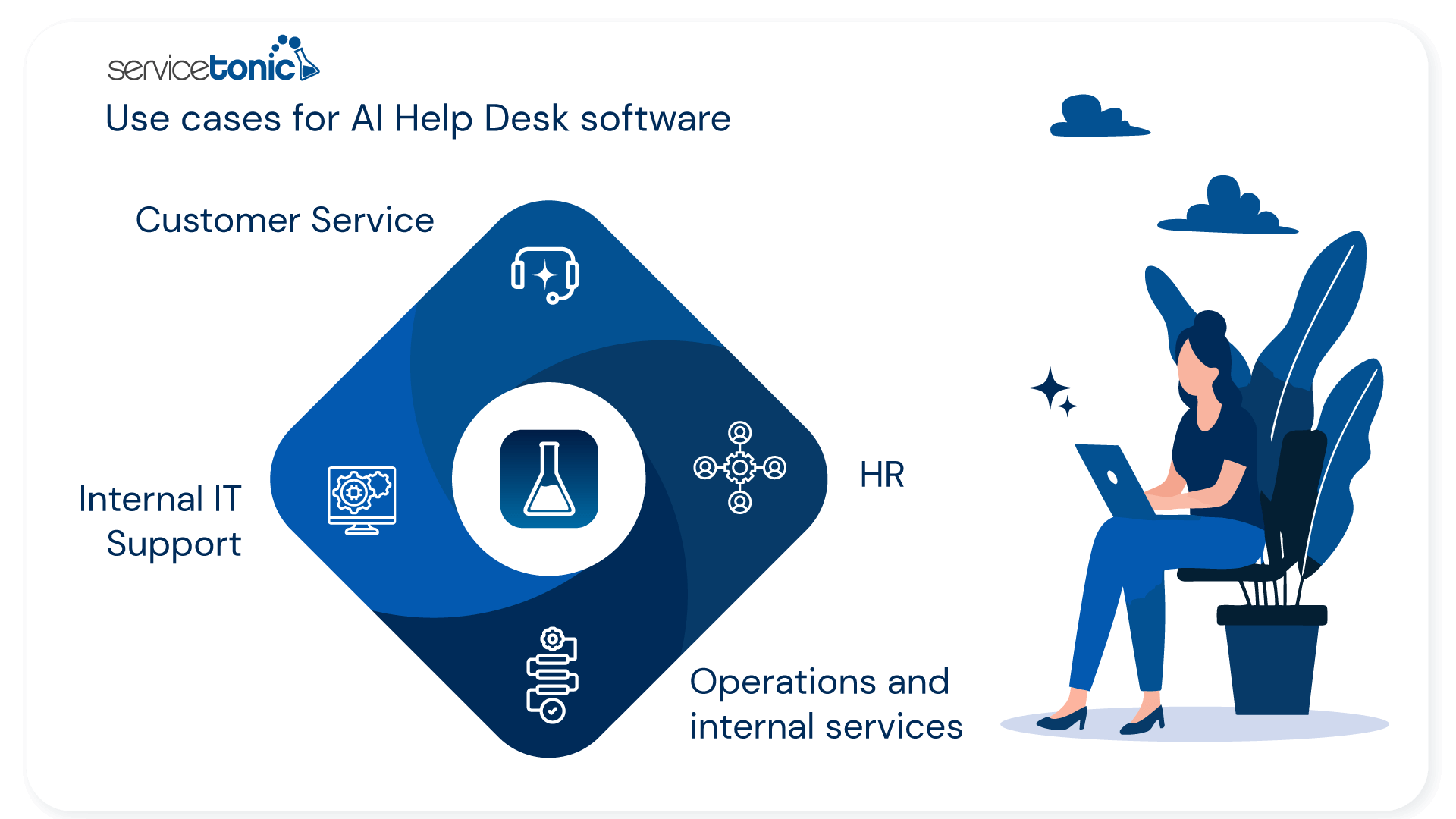
Use Cases of AI Help Desk Software
AI Help Desk Software adapts to different departments and contexts, allowing for improved request management and user experience in multiple areas of the organization.
These are some of the most common use cases.
Customer Service
In the customer service area, the AI Help Desk allows managing large volumes of inquiries in an orderly and efficient way. The automation of answers to frequently asked questions and the correct prioritization of incidents help reduce response times and offer more consistent and personalized attention across all channels.
Internal IT Support
In IT support environments, the AI Help Desk Software facilitates the management of technical incidents, access requests, or recurring employee problems. By centralizing information and automating repetitive tasks, IT teams can focus on critical incidents and improve the internal user experience.
Human Resources (HR)
HR departments use the AI Help Desk to respond quickly to inquiries about internal policies, holidays, payroll, or onboarding processes. This reduces the team’s administrative burden and allows employees to access the information they need quickly and autonomously.
Operations and Internal Services
In operations areas, the AI Help Desk helps coordinate requests related to internal processes, maintenance, logistics, or service management. Visibility over the status of each request and workflow automation allow improving operational efficiency and reducing management times.
Frequently Asked Questions
What is an AI Help Desk?
An AI Help Desk software combines traditional support management with artificial intelligence technologies to automate tasks, assist agents, and offer faster, more efficient, and personalized customer service.
How Can I Use an AI Help Desk to Improve Customer Service?
By implementing an Artificial Intelligence system in Help Desk software, companies can offer continuous attention through Virtual Assistants in functionalities such as chat, chatbot, or the User Portal, thus reducing response times, thereby achieving significant improvement in customer service.
Can I Train the AI?
Yes. It is possible to train the AI with internal data, such as articles from the knowledge base, proprietary URLs, and ticket history, so that the system adapts to the language, processes, and culture of the organization to offer more precise answers.
What Advantages Does an AI Help Desk Software Bring Compared to a Traditional One?
An AI Help Desk software allows improving customer service by offering more precise answers, automatically categorizing tickets, and, with business rules, assigning them to the appropriate agent. In addition, it facilitates the writing and translation of messages into the customer’s language and guarantees continuous 24/7 attention, ensuring an agile and satisfactory experience.
How Does Artificial Intelligence Help Improve Customer Service?
Virtual Assistants allow customers to obtain more precise and faster answers to their inquiries, available at all times, and Copilot offers agents advanced functionalities that help them streamline their daily work, write responses with greater precision, and resolve incidents more efficiently.
Conclusions
Adopting AI Help Desk software to improve customer satisfaction is a strategic decision that drives operational efficiency and service quality. Copilot AI and AI Agents allow offering faster, more consistent support available at all times.
The incorporation of AI-based tools not only improves the customer experience but also optimizes support team resources, increases productivity, and reinforces the company’s image as an innovative organization, focused on the user and continuous service improvement.