
Table of Contents
What is an SLA (Service Level Agreement)?
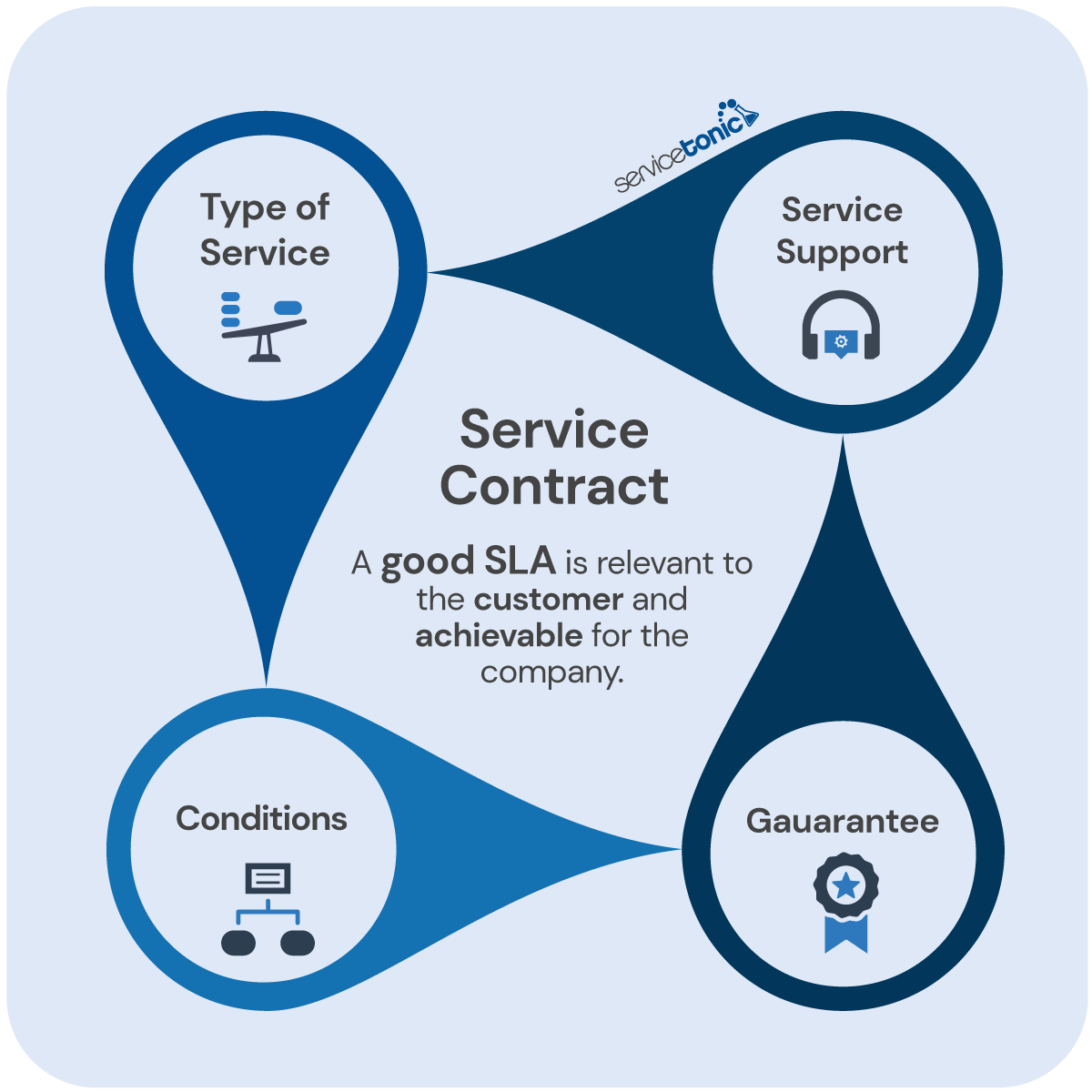
A SLA (Service Level Agreement) is a formal document that establishes the service conditions between a service provider and their client.
In this agreement, the commitments accepted by both parties are clearly defined and measurable, guaranteeing effective and transparent collaboration between both parties.
SLAs establish quantifiable metrics, such as maximum time to resolve incidents, service availability levels, or the responsibilities of each party. Thanks to these indicators, it is possible to objectively evaluate if the agreed contract commitments are being met.
Service Level Agreements (SLA) serve to establish measurable indicators to regulate the service we provide and thus ensure compliance with our customers’ expectations.
What is the main objective of an SLA?
The main objective of an SLA is to ensure that the services provided meet the quality levels agreed upon between the service provider and the client.
An SLA seeks to align the provider’s objectives with the client’s real needs, defining indicators that allow evaluating service effectiveness, such as service times or response times.
Its goal is to maintain the balance between commitment and satisfaction between client and provider, offering a framework that fosters trust, improves service management, and guarantees contract compliance.
How to design a good SLA?
The key to designing an effective SLA is guaranteeing that our company can fulfill the agreement, which is crucial. By establishing realistic agreements, we will examine both the service we provide and the internal structure we use to provide it.
Service Level Management is essential, as it guarantees secure quality that fosters customer loyalty and improves our services.
Designing an SLA requires planning and, above all, understanding the customer’s needs and how the provider can cover them.
Analyze customer needs
The first, indispensable step to creating an SLA is understanding what the customer expects from the service provider, what their expectations are. Priorities must be identified so the contract reflects their needs.
Define objectives
SLA objectives must be specific, measurable, and realistic. Each indicator must have a defined reference value, measurement method, and evaluation frequency. This allows measuring performance objectively and avoiding ambiguous interpretations. All these measurements can be carried out with ServiceTonic help desk software.
Establish metrics and KPIs
Key Performance Indicators (KPIs) reflecting service quality must be established, such as average resolution time, incident compliance percentage, or customer satisfaction level. Metrics that truly add value should be prioritized, avoiding those that might distract attention.
Define roles
The SLA must specify who is responsible and what their responsibilities are. Both the provider and the client must know their functions, deadlines, and specify communication channels. This facilitates coordination and avoids communication problems.
Document procedures
It is necessary to draft an action plan for incidents, specifying how problems will be managed, how priority levels will be defined, and what the response and resolution times will be.
Review and approve the agreement
Before implementing the agreement, both parties must review and validate it; both provider and client must understand the agreement’s content, the metrics to be used, and what procedures will be carried out.
Together, these components allow building a solid, transparent, and results-oriented SLA, ensuring service quality and strengthening the relationship between provider and client.
SLA management does not end once the service has been provided. It is important to analyze our customers’ satisfaction level through, for example, regular surveys. It is fundamental to know their opinion to understand the effectiveness of our agreement management and adjust improvements if necessary.
In short, SLAs are essential for any service company. They strengthen the relationship with the client because they will clearly understand what is being offered, while we know exactly what is expected of our company.
Service Desks like ServiceTonic allow you to manage and automate Service Level Agreements, making it easy to assign a specific priority or resolution time to each ticket according to the SLA type.
Types of SLA
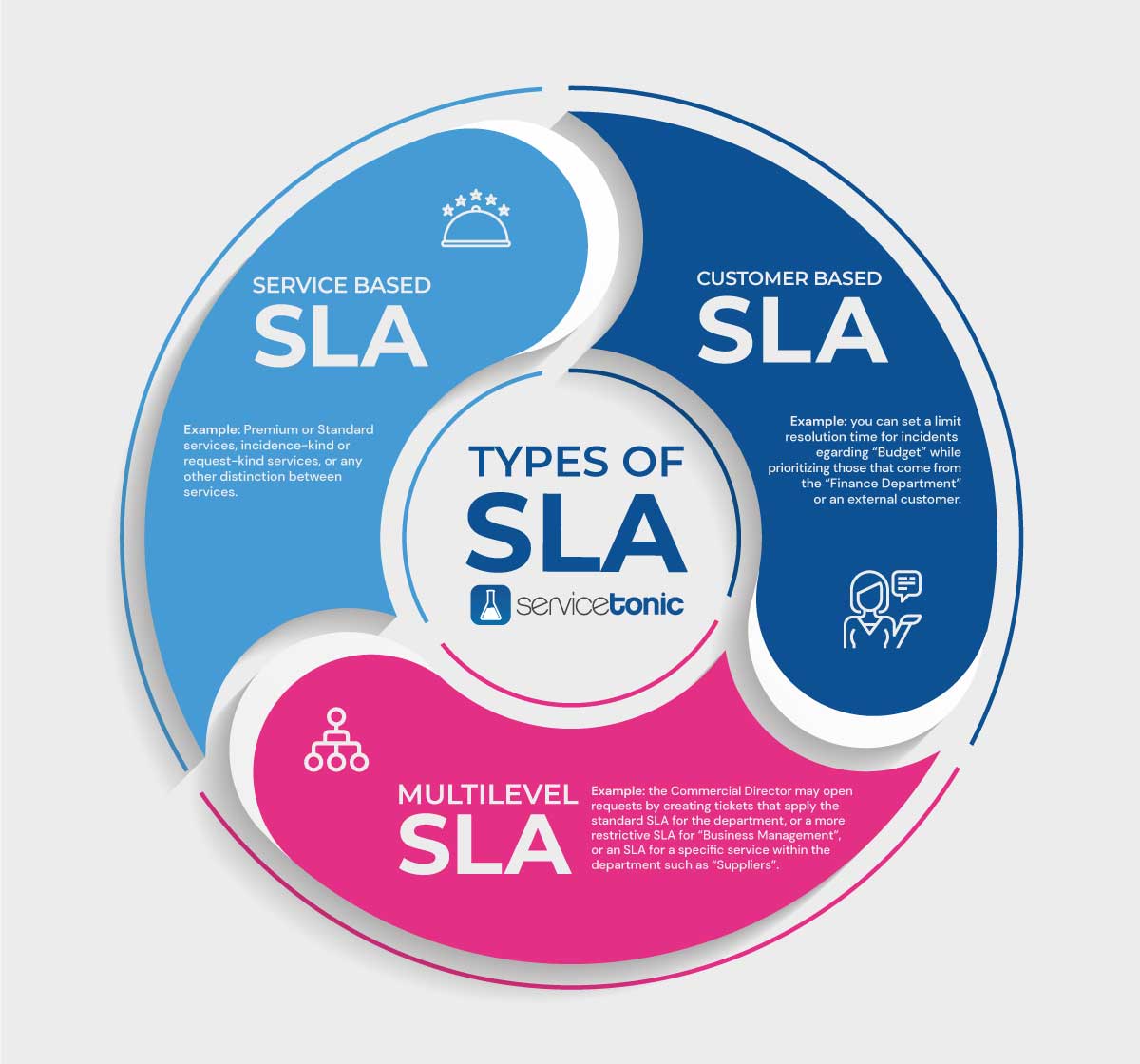
There are 3 types of SLA:
Service-based SLA:
Applies a standard SLA to all customers contracting the same service. It is useful when our company offers various services with different resolution and response times.
For example, Premium services and Standard services, incident-type services and inquiry-type services, or any distinction between services.
Learn more about service based SLA
Customer-based SLA
Applies to all services contracted by the same customer, a group of customers, or a same business area.
For example, it can determine a resolution time limit for “budget request” type incidents, while prioritizing those coming from the “finance department” or an external client.
Learn more about customer based SLA
Multilevel SLA
Combines service SLA, customer SLA and also applies at a corporate level for all users in an organization. Multilevel SLAs avoid duplications and inefficiencies between various agreements, making it possible to integrate several conditions into the same system.
For example, the person directing the Commercial area can open requests creating tickets that apply the standard SLA for the department, or a more restrictive SLA for “business management”, or an SLA for a specific service within their department such as “suppliers”.
ServiceTonic helps you automate all SLAs you want to define, even the most specific ones for your company.
In addition to those proposed by ITIL, ServiceTonic automates another SLA:
Contact-based SLA
Applies solely to a user within a service that already has its standard SLA. It is useful for offering different treatment to a customer we want to capture, retain, or give specific attention to.
Learn more about contact based SLA
Benefits of using SLAs
- Improves service provided. Reduction of incident resolution time or request delivery.
- Facilitates communication. The service desk team or service provider knows customer expectations.
- Mutual agreement. The SLA is mutually accepted by the client and the service provider.
- Avoids disputes. Having things clear and in writing will avoid future disputes.
- Compliance measurement. Agreement compliance can be measured objectively.
- Provides a management standard. Defines service delivery rules between provider and recipient.
Frequently Asked Questions
Below, we resolve some of the most common doubts regarding SLAs:
What is an SLA?
An SLA or Service Level Agreement is a formal document establishing service conditions between a service provider and their client. It defines the expected service level.
What is the objective of an SLA?
The main objective of an SLA is ensuring that provided services meet quality levels agreed upon between the service provider and the client.
What are the key functions?
Key functions are: firstly, defining what work will be delivered and what metrics must be performed to meet the agreement; it also measures performance level and fosters trust between provider and client.
Is SLA implementation possible with ServiceTonic?
Yes, ServiceTonic allows automating SLA measurement and enables defining established metrics. Additionally, the dashboard provides real-time information on your SLAs.
What is the difference between an SLA and an OLA?
The difference between an SLA and an OLA is that an SLA is an external agreement between the service provider and the client, while an OLA (Operational Level Agreement) is an internal agreement between departments of the same company.
Use ServiceTonic to automate your Service Level Agreements and access dashboards with real-time information, notifications, and alerts about your automated Service Level Agreements.
Contact us to learn how ServiceTonic helps you comply with your SLAs. Please complete the following form and an agent will contact you as soon as possible.