
Multichannel and multilevel customer service combines two ideas: customers can get in touch through the channel they prefer (phone, email, portal, chat, WhatsApp or in person), and their request is resolved at the right support level, with escalation when the first level cannot resolve it. Multichannel refers to where the request comes in; multilevel, to who resolves it. For this to work, all channels and levels must share the same ticket and history. The sections below explain how to organize both, with an escalation example.
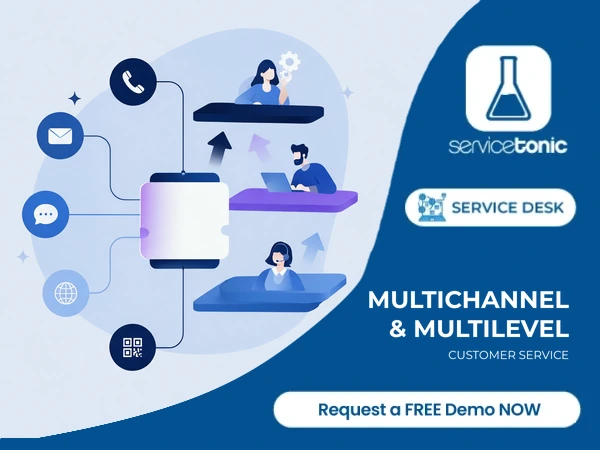
What is the difference between multichannel and multilevel customer service?
| Multichannel | Multilevel | |
|---|---|---|
| Answers the question | Where does the customer get in touch? | Who resolves the request? |
| Organized into | Input channels | Support level |
| Goal | Letting customers choose how to get in touch | getting each case to whoever can resolve it |
| Risk if it fails | Requests los or duplicated across channels | Cases stuck at a level that cannot resolve them |
Both are based on the same principle: customers receive the same information and the same treatment regardless of the channel they use or the level handling their case. This is known as a single point of contact (SPOC).
Which input channels does multichannel customer service include?
| Channel | Best suited for |
|---|---|
| Self-service portal | Requests with forms, status checks and knowledge base searches |
| Non-urgent queries or those with attached documents | |
| Phone | Urgent cases or costumers who prefer to speak to a person |
| Chat | Quick questions while the costumer is browsing the website |
| Fast contact from a mobile phone, with asynchronous conversation | |
| In person | Store, offices or points of sale |
| QR code | Incidents involving a specific device or facility |
What matters is not having many channels, but making sure they all end up in the same ticket queue. If a request that comes in through WhatsApp is not logged the same way as one that comes in by phone, the customer will get different answers and the team will not have the full picture. The article on omnichannel help desk software explains how to centralize them.
What support levels are there?
Support is usually organized into three or four levels:
| Level | Who handles it | What it resolves |
|---|---|---|
| Level 0: self-service | The customers themselves, using the portal, the knowledge base or a virtual assistant | Frequent questions and simple tasks |
| Level 1: first contact | Customer service agents | Common queries, logging and classifying the case |
| Level 2: specialists | Technicians or experts in a specific area | Common queries, logging and classifying the case |
| Level 3: experts or third parties | Development, the manufacturer or an external supplier | Complex problems or those that depend on another organization |
In organizations with several sites or a network of points of sale, levels can also be organizational: point of sale, local office and headquarters. The logic is the same: each level resolves what it can and escalates what it cannot.
How does escalation between levels work?
Escalating a ticket means passing it to another level or group when the current one cannot resolve it or when the deadline is about to expire. There are two types:
- Functional escalation: the ticket goes to a group with more technical expertise, for example from the first level to specialists.
- Hierarchical escalation: a manager is alerted because the case is critical, affects an important customer or the SLA is about to be breached.
To make sure escalation does not penalize the customer, it should include the full ticket history, the new owner should be notified automatically and the customer should know their case is still moving forward. Escalation rules should be defined in advance: which categories go to each level, how long a ticket can stay at each one and who is alerted.
Escalation example: a car brand with a dealership network
A car brand has its headquarters, an office in each country and a network of dealerships. A customer notices a fault in their new car’s infotainment system and sends a WhatsApp message.
| Step | What happens | Level |
|---|---|---|
| 1 | The WhatsApp message becomes a ticket with the customer’s and the vehicle’s details | Intake |
| 2 | A customer service agent checks the knowledge base: there is no documented solution. They book an appointment at the dealership. | Level 1: customer service |
| 3 | The dealership inspects the car and updates the software, but the fault persists. It records the diagnosis in the same ticket. | Level 2: dealership |
| 4 | the ticket is escalated to the country office, which finds that other customers have reported the same fault.. | Level 3: local office |
| 5 | The local office escalates it to headquarters, which confirm a manufacturer update and distributes it across the network | Level 3: headquarters and manufacturer |
| 6 | The dealership applies the update, the customer confirms it works and the ticket is closed. The solution is added to the knowledge base. | Closure |
At every step, the customer receives consistent information, because all levels see the same history. And the next time another customer reports the same fault, the first level will have the solution documented.
What challenges does multichannel and multilevel customer service involve?
- Management support: changing how customers are served affects several departments and needs clear backing.
- Channel integration: all channels must log requests in the same system.
- Access to information: each level needs to see the full history of the customer and the case.
- Clear escalation rules: what is escalated, to whom and within what timeframe.
- Data analysis: measuring by channel and by level to detect where cases get stuck.
What are the benefits?
- More satisfied customers, who choose how to get in touch and always receive the same information.
- More control over the process, with traceability for each case from
- intake to closure.
- Better use of resources, because each level focuses on the cases it should handle.
- Continuous improvement, thanks to solutions added to the knowledge base and data by channel and level.
- A shared service culture across all of the organization’s points of contact.
To measure the results, first response and resolution time metrics are explained in how to reduce customer response time.
What sets ServiceTonic apart in multichannel and multilevel customer service?
ServiceTonic is customer service software that brings requests from the web, the portal, email, phone, chat, QR codes and WhatsApp into a single queue. Support levels, groups and escalation rules are configured without programming, and every level works on the same ticket and history. SLAs issue alerts before each deadline expires, and dashboards show metrics by channel and by level.
Frequently asked questions
What is the difference between multichannel and omnichannel customer service?
In multichannel customer service, customers can get in touch through several channels. In omnichannel service, those channels are also connected: if a customer starts on chat and continues by phone, the agent sees the whole conversation. For multichannel service to work well, in practice it has to be omnichannel.
What is a single point of contact (SPOC)?
It is the model in which all customer requests go through a single point, which logs and classifies them and either resolves or escalates them. This way, customers do not need to know which department to contact.
How many support levels should there be?
Three or four is usual: self-service, first contact, specialists and, if needed, experts or external suppliers. More levels lengthen resolution times and increase handovers.
What is the difference between functional and hierarchical escalation?
Functional escalation passes the ticket to a group with more technical expertise. Hierarchical escalation alerts a manager when the case is critical or the deadline is about to be missed. The same ticket may need both.
How can customers avoid repeating information when they switch channel or level?
By recording all interactions in a single ticket with a shared history. That way, whoever handles the customer on each channel or level can see what has already been done and continue without asking again.
Conclusion
Adding channels is the easy part of multichannel customer service; the hard part is making them all lead to the same place. A new channel that is not integrated into the shared queue does not improve service: it fragments it. The same goes for levels: every handover without history forces the customer to start again. That is why, before opening a channel or creating a level, it is worth asking whether the case will be able to follow its entire journey in a single ticket.
Would you like to see how to centralize all your service channels and levels in ServiceTonic? Request a demo and see how escalation works with your own processes.