
Although both share the same goal — helping users when there’s a need — each one does it with a different intent: the Help Desk focuses on solving problems quickly, while the Service Desk, in addition to resolving incidents and requests, broadens its scope to cover the quality of the services the company delivers.
This evolution reflects different ways of understanding support and the role a service center plays in delivering the experience companies want to offer their users.
Help Desk vs Service Desk
When you look at the differences between Help Desk and Service Desk, you see that a Help Desk takes a reactive approach and therefore focuses on solving immediate incidents so users can keep working.
Its goal is to restore service as quickly as possible and equip the support team with a tool to handle and resolve requests fast, keeping users productive.
A Service Desk, on the other hand, takes a broader, more proactive approach focused on end-to-end service management. Beyond solving problems, it covers the management of requests, changes, assets, and processes that connect the support team with other areas of the organization.
This model prioritizes a holistic view of the service and aims to improve the user experience through more complete coordination and a management system that enables continuous oversight of the service lifecycle, anticipating needs and ensuring greater operational stability.
Its goal is to make sure all technology services run consistently, efficiently, and aligned with the organization’s needs.
Together, these differences show a more reactive approach in the Help Desk and a more proactive approach in the Service Desk, which determines how each structure contributes to the operation and maturity of the support system.
Based on these needs, Help Desk software and Service Desk software are built with different functionalities, tailored to the type of management and level of complexity each model requires.
What is a Help Desk software?
A Help Desk software is a tool designed to manage and quickly resolve users’ incidents and immediate needs.
This type of solution relies on a ticketing system that lets you log, organize, and prioritize each incident, making sure every ticket has the information needed for clear management and smoother communication between the support team and users — which translates into more efficient service.
While it can be used as a standalone tool, it can also be embedded within a broader service management strategy, where it complements the more advanced processes of a Service Desk.
Key features of a Help Desk software
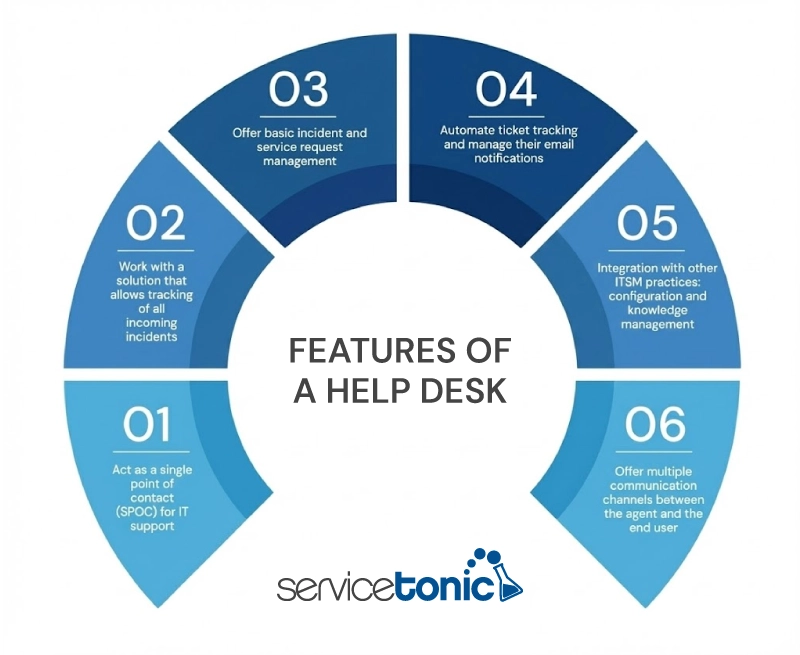
Some of the features a Help Desk software should provide are:
- Act as a single point of contact (SPOC) for IT support
- Work from a single solution that lets you effectively track and manage all incoming incidents
- Offer basic incident and service request management
- Automate ticket tracking and handle email notifications
- Integrate with other ITSM practices: configuration management and knowledge management
- Offer communication channels between the agent and the end user, such as email integration, chats, user portal…
Help Desk software is characterized by a reactive approach, geared toward resolving unexpected incidents — both internal ones and those tied to the services the company offers — as they arise.
To do this, it centralizes customer service and the communication between the support team and users, allowing each case to be logged, prioritized, and tracked through an organized system that ensures more effective resolution.
It contributes to service management by keeping clear control of incidents and supporting operational continuity within the organization.
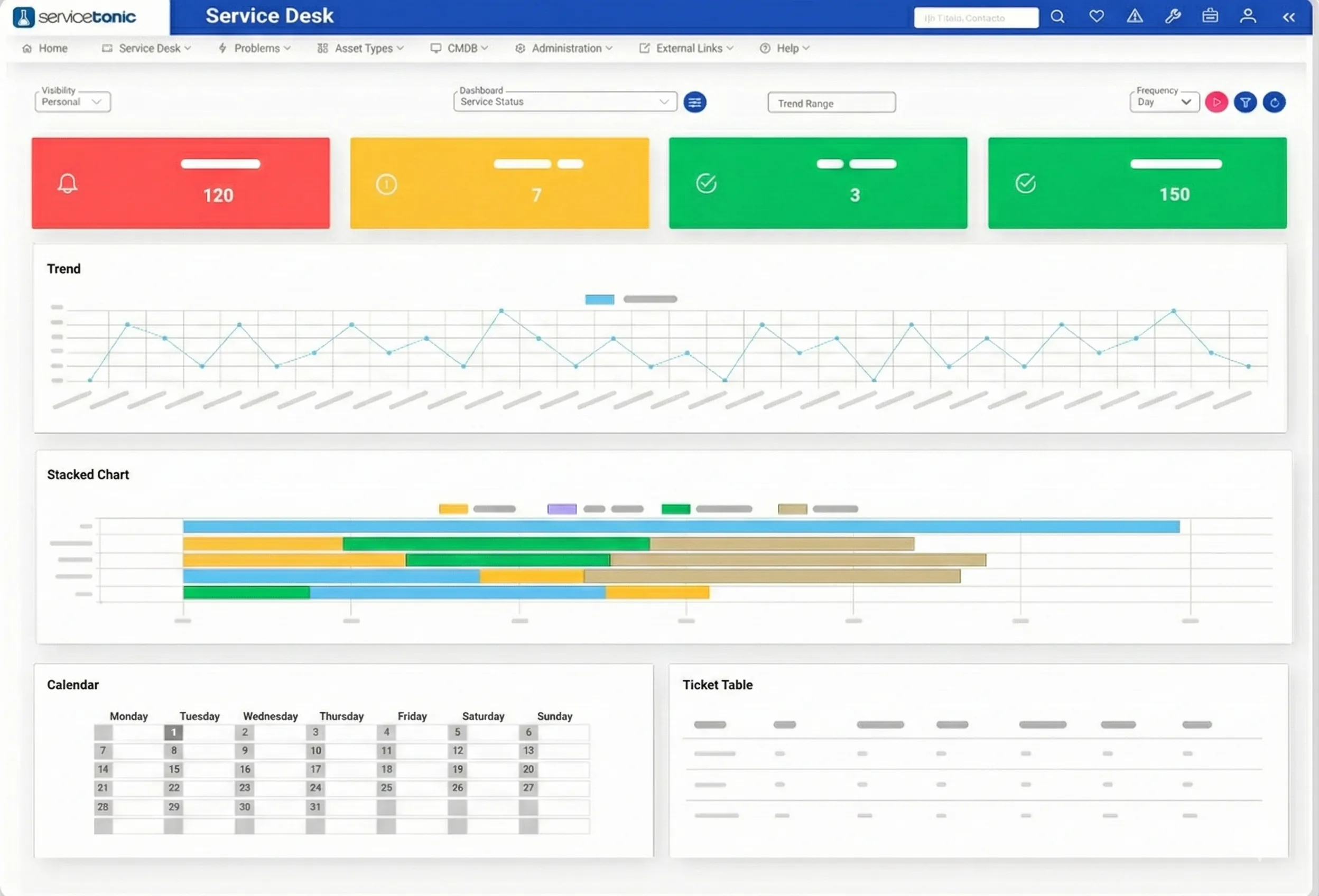
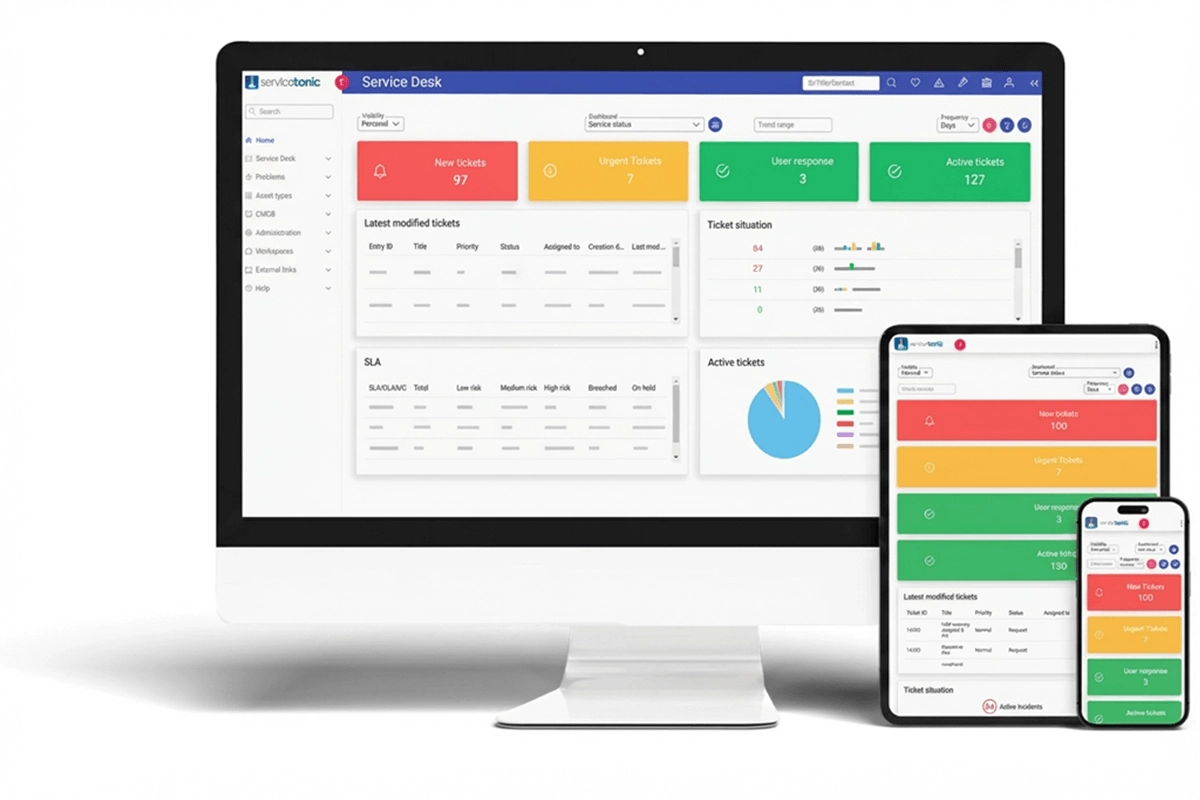
*Example of ServiceTonic’s custom dashboard
What kind of companies need a Help Desk solution?
A Help Desk software is especially useful for companies that handle a steady volume of incidents or requests — whether from customers, internal users, or customer service teams.
Any organization that depends on technology for its day-to-day operations can benefit from this type of solution, since it enables structured support and reduces response times.
Companies with an IT department are usually the first to roll it out, as they need a tool that lets them log, prioritize, and resolve technical problems efficiently.
It’s not limited to the technology side: companies with customer service teams, after-sales services, or commercial support also turn to a Help Desk system to manage inquiries and ensure smooth communication with users.
What is a Service Desk software?
A Service Desk software is a solution designed for end-to-end service management within an organization. Unlike a Help Desk, which focuses on resolving immediate incidents, a Service Desk covers a broader set of processes that allow you to manage the entire lifecycle of technology services in a structured way.
This kind of tool includes essential functions like incident management, request handling, change coordination, and asset management, providing a unified view of the infrastructure and user needs.
Its goal is to make sure services run consistently, stably, and aligned with business priorities.
Thanks to this holistic view, a Service Desk doesn’t just respond to problems when they happen — it also fosters a more proactive, strategic operation, strengthening service consistency and raising user satisfaction across the organization.
A Service Desk software typically includes elements such as a Service Catalog or asset databases (CMDB).
Key features of a Service Desk software
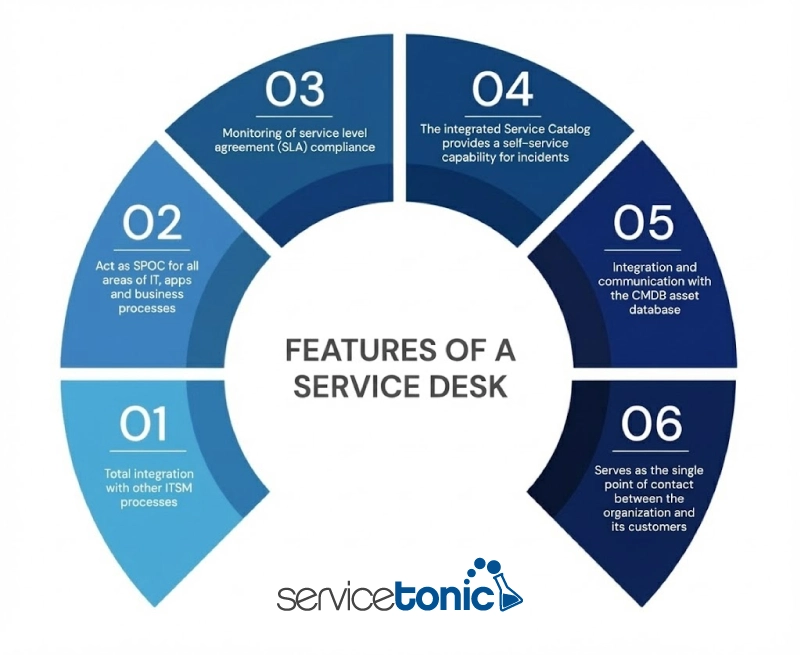
Some of the most prominent features of a Service Desk software are:
- Full integration with other ITSM processes
- Act as SPOC for all areas of IT, applications, and business processes
- Track Service Level Agreement (SLA) compliance
- Built-in Service Catalog that delivers self-service for incidents and service requests
- Integration and communication with the CMDB asset database.
Service Desk software is the older sibling of Help Desk software, and it acts as the single point of contact between the organization and its customers. Unlike Help Desk software, which is reactive by nature, Service Desk software enables the planning of preventive maintenance that anticipates and avoids future incidents.
What kind of business needs a Service Desk software?
A Service Desk software is especially well-suited for businesses that need structured service management aligned with ITSM (IT Service Management) practices.
This type of solution is essential for organizations that depend on multiple internal processes and technology services that need to stay stable, traceable, and aligned with business goals.
Companies with an IT department whose responsibilities go beyond simply resolving incidents — such as asset management, change management, request management, or oversight of critical services — typically need a Service Desk to maintain operational control under a clear ITSM framework.
Likewise, businesses with complex service delivery models — such as telecom companies, consultancies, managed service providers (MSPs), public institutions, or large corporations with multiple support tiers and several departments — benefit from this kind of platform.
Any organization looking to raise its operational maturity, improve traceability, centralize processes, and deliver a consistent user experience will find a Service Desk software to be a key tool.
Its ability to coordinate teams, anticipate needs, and optimize resources makes it a foundational piece within a well-implemented ITSM approach.
Does ServiceTonic meet your needs?
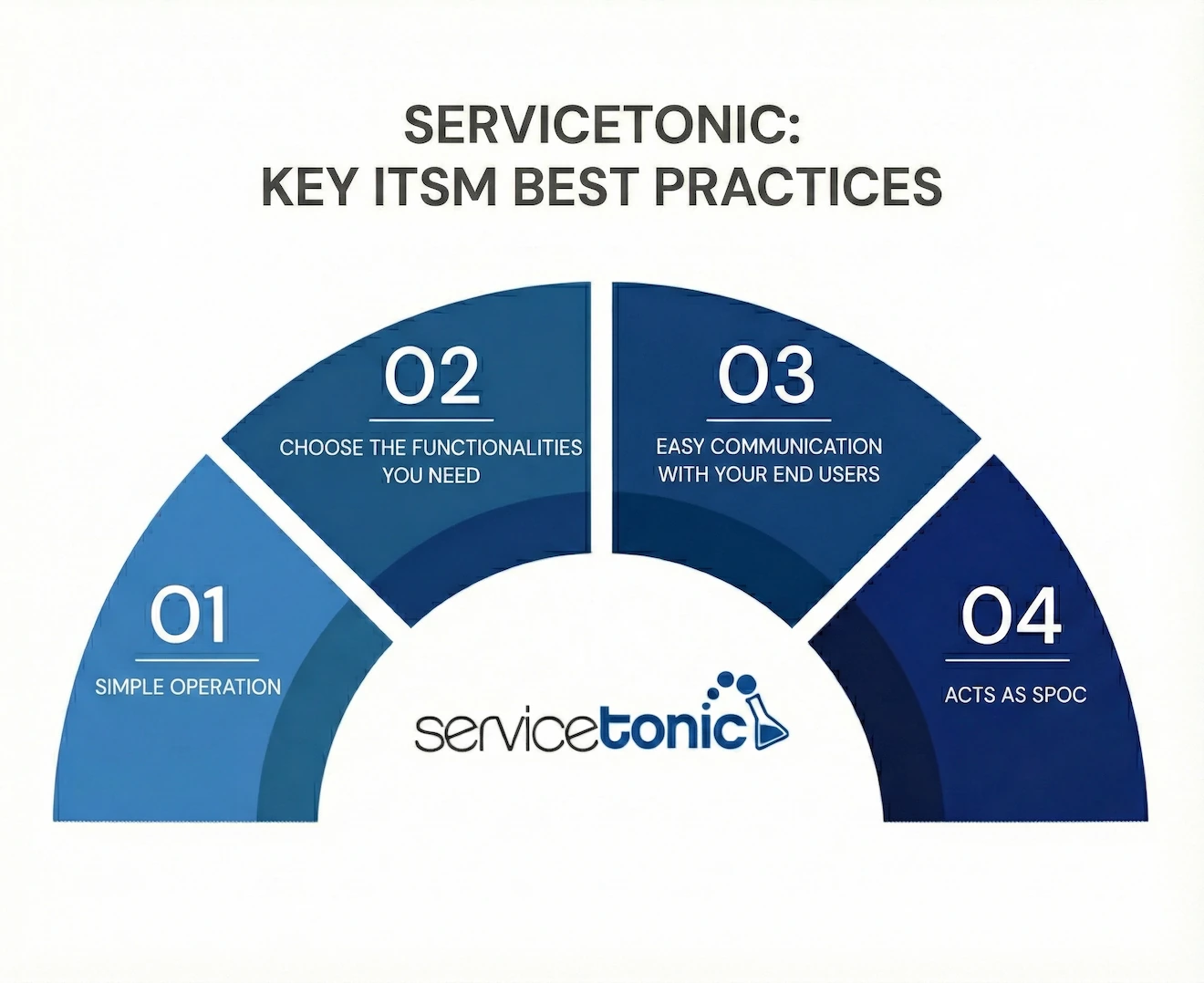
Once you understand the differences between Help Desk software and Service Desk software, it’s critical that the tool you pick fits the expectations and best practices your organization requires:
Easy to use
Both your organization’s agents and your end users or customers will work with the chosen software every day. ServiceTonic is a Help Desk and Service Desk software fully configurable to your needs and built around an intuitive, easy-to-use design — no programming skills required.
Pick the features you need
ServiceTonic lets you select only the features each organization needs, adapting to different levels of complexity and types of operations. This flexibility lets you build a tailored solution aligned with each company’s goals and internal processes.
If your goal is to automate processes, ServiceTonic puts tools at your disposal such as business rules, maintenance contract management, configurable workflows, and automatic actions that streamline repetitive tasks and improve operational efficiency.
Identifying the real needs of the support department or area is the first step to getting the most out of the platform. Once those needs are clear, ServiceTonic lets you turn on the right features to cover them precisely and at scale, ensuring more organized, efficient service management aligned with your organization’s strategy.
Easy communication with your end users
ServiceTonic offers different communication channels between your organization’s agents and your users:
- Chat: ServiceTonic includes a chat channel between the User Portal and your organization’s agents, designed to speed up communication and deliver immediate support when users need help.
- Chatbot: Delivers instant responses to common inquiries through an automated assistant. When the conversation requires more complex intervention, the system routes the chat to an available agent. If no agents are connected at that moment, a ticket is automatically created for follow-up.
- ForumTonic: ServiceTonic includes a collaborative tool that acts as a discussion and engagement space. Both agents and users can interact across different channels and topics, with permissions configurable by each participant’s role. It’s an ideal solution for sharing knowledge and resolving questions collectively.
- Mail: The system lets you create a ticket directly from an email, automatically assigning it to the responsible agent for follow-up and resolution.
- User Portal: A fully customizable portal tailored to the customer’s needs. It enables direct communication between users and agents, delivering a fast, organized experience adapted to each organization.
Acts as a SPOC
ServiceTonic acts as a SPOC for all areas of IT, applications, and business processes — that is, it unifies all information channels into a single point.
ServiceTonic includes all of these capabilities, and many more.
Designed with the goal of being your Help Desk or Service Desk solution, our software offers a high level of optimization that lets you select the specific features your company needs. Plus, its broad customization makes it easy to adapt the tool to your organization’s needs without programming skills.
- Optimized for ITIL
- Ticket automation
- Tracking of all incidents and requests
- Easy use of the data collected
- Adapted to all kinds of devices
- Powerful tool for delivering great customer service
- Software to support IT departments and many others
- Create satisfaction surveys for your customers
ServiceTonic can be your Help Desk software or your Service Desk software thanks to its high level of customization and optimization.
FAQ
What is a Service Desk?
A Service Desk is a single point of contact (SPOC) between users and the IT department in charge of service management. Its job is to coordinate incidents, requests, changes, and assets, providing a holistic, proactive view of the service. It’s an essential part of ITSM practices, making sure technology services stay aligned with business needs.
What are the levels of a Service Desk?
A Service Desk can include the same levels as a Help Desk, but extended within service management:
- Tier 1: receiving requests and resolving low-complexity incidents.
- Tier 2: advanced resolution, change management, and coordination with other departments.
- Tier 3: expert support, problem analysis, asset management, and strategic actions aligned with ITSM.
- Tier 4 (external vendors): when third parties step in for specialized services or support contracts (external SLAs).
What is a Help Desk?
A Help Desk is a system geared toward quickly resolving users’ incidents and immediate problems. Its approach is mainly reactive: it responds to specific requests to restore operations as fast as possible. It usually focuses on efficiency, ticket logging, and direct handling of technical inquiries.
What are the levels of a Help Desk?
Help Desks are typically structured into several tiers to better organize support:
- Tier 1 (Basic support): receives incidents, runs the first diagnosis, and resolves common problems.
- Tier 2 (Specialized support): handles incidents that require more technical knowledge or advanced analysis.
- Tier 3 (Experts or developers): handles complex issues related to architecture, development, or advanced configurations.
Help Desk vs. Service Desk: which one does my company need?
The choice depends on the level of operational maturity and the business needs:
Help Desk if your company needs:
- To resolve incidents quickly
- To reduce response times
- A ticketing system for basic support
- Agility without overly complex processes
Service Desk if your company needs:
- To manage complete services under an ITSM framework
- To connect IT with other departments
- To control assets, changes, requests, and processes
- More proactive and strategic support
In general:
Small companies or basic support → Help Desk.
Growing companies, corporations, or complex environments → Service Desk.
Conclusions: What’s the difference between a Help Desk and a Service Desk?
The main difference comes down to their approach:
Help Desk:
- Reactive
- Focused on resolving immediate incidents
- Geared toward operational efficiency and the ticketing system
Service Desk:
- Proactive
- Manages services end-to-end (incidents, requests, assets, changes…)
- Focused on service quality, user experience, and ITSM alignment
In short: the Help Desk solves problems; the Service Desk manages services.
More information