
Help Desk dashboards allow you to view each agent’s workload, identify imbalances, and reassign tickets before delays or SLA breaches occur.
By combining data such as the number of requests, priority, status, and expected resolution date, this dashboard provides a more realistic view of the team’s workload and helps support better decisions to optimize ticket management and the user experience.
Why It Is Important to Balance the Workload
Balancing the workload is important because an uneven distribution can cause some agents to accumulate too many tickets while others still have available capacity. This affects response times, increases the risk of SLA breaches, and can reduce service quality.
Moreover, assigning the same number of tickets to each agent does not necessarily mean that the workload is evenly distributed. Factors such as priority, complexity, estimated resolution time, and the expertise required mean that some requests demand more effort than others.
A good management strategy should therefore analyze workloads based on data rather than ticket volume alone. This enables managers to identify areas for improvement, anticipate problems, and maintain better team performance.
What Data a Dashboard Needs to Measure Workload
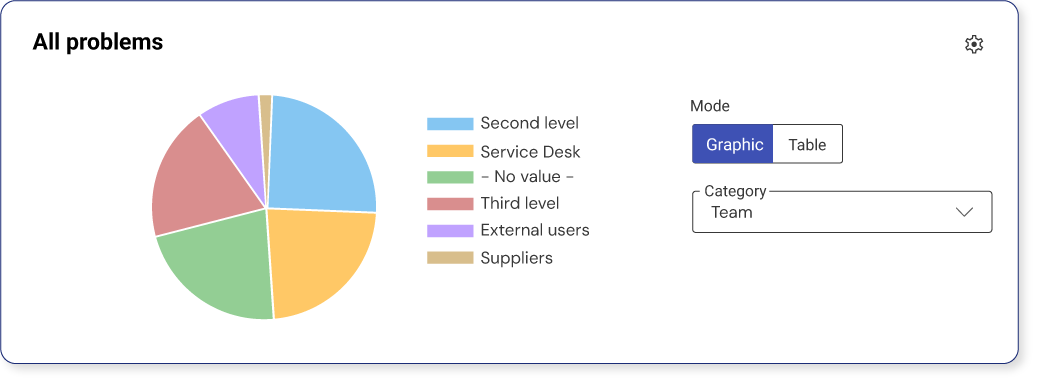
To measure workload accurately, the dashboard must be adaptable to each agent, team, or service and display the relevant indicators for each case. This allows managers to see in real time how requests are distributed, identify deviations, and take action before they affect performance or service quality.
This data can be displayed using charts, tables, counters, or calendars configured according to the needs of each service.
ServiceTonic dashboards allow different types of panels to be combined, presenting information clearly and adapting it to the needs of each service.
Some of the most useful data includes:
- Open and pending tickets by agent
- Request priority and status
- Expected resolution dates
- SLAs approaching their deadlines
- Critical tickets
- Ticket volume by team, category, or service
- Average response and resolution times
- Reopened or unassigned tickets
Effective data management helps identify workload imbalances and supports decisions based on up-to-date information. Data should be presented clearly so that managers can detect patterns, deviations, and issues without having to review every ticket manually.
How to Balance the Workload Among Agents
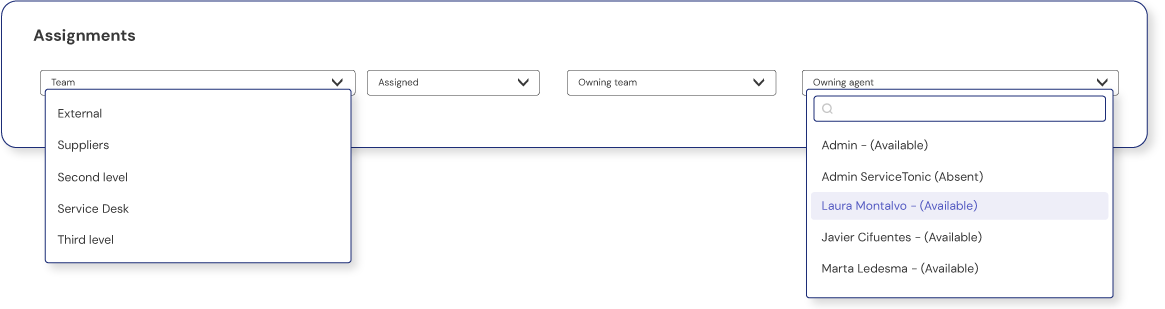
In addition to making it easier to track KPIs, dashboards show how the workload is distributed among agents. They display how many tickets are assigned to each agent and allow active requests to be segmented by owner, service, team, or support level.
This view helps quickly identify which agents are overloaded and which have more capacity available. Managers can then reassign tickets before an imbalance affects response times, SLA compliance, or service quality.
Viewing the Tickets Assigned to Each Agent
To view each agent’s workload, a table or chart can be added to the dashboard and the “Assigned” dimension selected. Active tickets are then segmented according to the person responsible for them.
The chart can display all requests for a service or apply more specific filters, such as showing only tickets managed by the second-level support team.
Detecting Overloads and Reassigning Tickets
When the dashboard shows that an agent has an excessive workload, the manager can access the details of their tickets directly from the chart.
From this list, it is possible to review the status, priority, and expected resolution dates. This information helps identify which tickets should be reassigned to other agents with available capacity.
How to Prioritize Workloads to Meet SLAs
To distribute requests effectively, it is not enough to check how many tickets are assigned to each agent. The complexity, urgency, and resolution times associated with each case must also be analyzed.
The number of assigned tickets does not always reflect the actual workload. An agent with fewer requests may be more overloaded if they are handling several critical or urgent cases that require immediate attention.
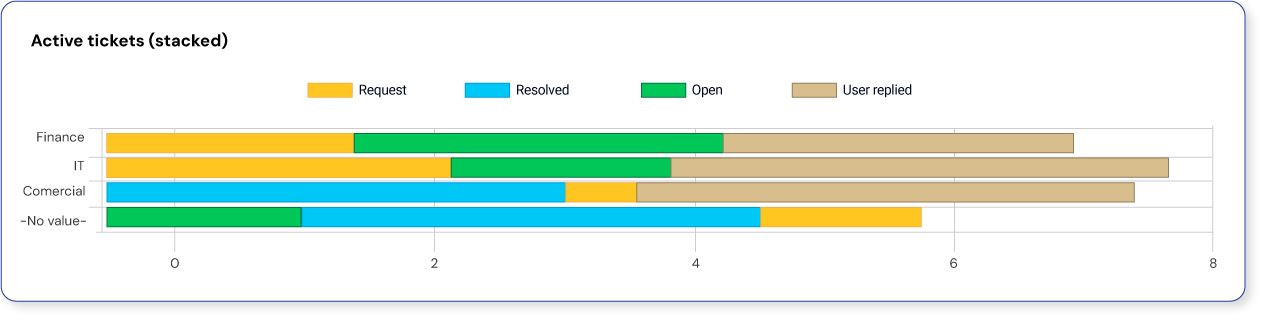
A dashboard should therefore make it possible to relate ticket volume to priority levels, request status, and the time remaining to meet SLAs. This view helps identify imbalances that would not be apparent from the total number of tickets alone and enables work to be redistributed before delays or SLA breaches occur.
Anticipating Delays and SLA Breaches
Cross-referencing ticket priority with the expected resolution date simplifies service level agreement (SLA) management and helps identify in advance which requests are most at risk of being delayed.
If an agent is handling several critical tickets or tickets approaching their deadlines, the dashboard can highlight this immediately, allowing the manager to reorganize tasks or temporarily reinforce the team.
Reassigning Critical Tickets
If an agent accumulates too many critical tickets, the manager can access those requests directly from the chart and decide which ones should be reassigned.
After making the changes, the dashboard can be used to check whether the workload is now more evenly balanced by priority.
How to Interpret Workload Accurately
Analyzing workload involves more than simply comparing the number of tickets. Two agents may have the same ticket volume yet face very different levels of effort.
Priority, complexity, estimated resolution time, proximity to the deadline, required expertise, and dependencies on other teams can significantly affect the actual workload.
A sound management strategy should therefore combine multiple data points and indicators. A well-configured dashboard provides a comprehensive view of ticket volume, urgency, and available capacity, helping identify areas for improvement and enhance team performance.
Key Indicators for Measuring Workload
| Indicator | Whar It Helps Identify | How to Take Action |
|---|---|---|
| Active tickets for agent | Agents with excessive ticket volumes | Redistribute requests |
| Critical tickets | Risk of overload due to urgency | Prioritize or reassign |
| SLAs approaching their deadlines | Potencial SLA breaches | Allocate additional support |
| Average resolution time | Delays or bottlenecks | Review processes |
| Reoponed tickets | Resolution quality issues | Analyze the causes |
| Workload by team or service | Imbalances between groups | Reallocate capacity |
| Unassigned tickets | Requests that may be overlooked | Assign owners |
The key is not to analyze a single data point, but to combine ticket volume, priority, resolution times, and available capacity to obtain a realistic view of the workload.
Benefits of Using Data to Balance Workloads
Analyzing ticket volume, priority, deadlines, and available capacity together allows work to be distributed more realistically. Managers can identify imbalances, anticipate potential delays, and take action before an agent’s excessive workload affects SLA compliance or support quality.
The main benefits include:
- Preventing agent overload
- Reducing response times
- Anticipating SLA breaches
- Redistributing tickets
- Identifying bottlenecks
- Improving capacity planning
A Help Desk dashboard solution makes it possible to adapt metrics and views to the needs of each team.
Common Mistakes When Analyzing Workload
A dashboard is only useful if its indicators are properly defined and interpreted. Some common mistakes include:
- Measuring only the number of tickets: Not all requests require the same amount of effort.
- Failing to distinguish by priority: A small number of critical tickets can create a heavier workload than many simple cases.
- Ignoring SLAs approaching their deadlines: Focusing solely on volume can conceal potential risks.
- Comparing agents with different roles: Their expertise and support level should be taken into account.
- Overlooking complexity: Some tickets require more time or coordination.
- Failing to connect the data with problem management: Recurring or reopened tickets may reveal underlying issues.
- Reviewing data too infrequently: Workloads can change throughout the day.
- Failing to act after identifying an imbalance: Visualizing the problem is not enough unless priorities or assignments are adjusted.
The goal is not to distribute tickets equally, but to distribute the workload realistically.
How to Adapt Workload Analysis to Each Service
Each support team needs to analyze different indicators depending on the type of service, ticket volume, and agent responsibilities.
This capability forms part of a broader approach to Help Desk software customization, allowing the management software to be adapted to each organization’s processes and objectives.
For example, a technical support team may primarily need to monitor critical tickets and SLAs approaching their deadlines, while a Human Resources service may prioritize pending requests, response times, or workload by category. Configuring specific indicators for each service makes it possible to interpret data in context and allocate available resources more effectively.
Frequently Asked Questions
How Can You Tell If an Agent Is Overloaded?
An agent may be overloaded when they have a high volume of tickets, several critical requests, or cases approaching an SLA breach. To identify this accurately, it is important to analyze the number of assigned tickets alongside their priority, status, complexity, and expected resolution date. A dashboard makes it possible to compare these indicators and determine which agents need support or task redistribution.
When Should a Ticket Be Reassigned?
A ticket should be reassigned when the agent responsible does not have enough capacity to handle it within the expected timeframe, especially if the request is urgent or approaching an SLA breach. Reassignment may also be appropriate when another agent has greater availability, experience, or expertise to resolve it. Tickets should be reassigned before excessive workloads cause delays or affect service quality.
How Does a Dashboard Help Distribute Tickets?
It helps identify overloaded agents, detect available capacity, and locate requests requiring priority attention.
Does Having More Tickets Mean Having a Heavier Workload?
Not necessarily. Workload also depends on priority, complexity, estimated resolution time, and the expertise required.
How Do Priority and SLAs Affect Workload?
Priority and SLAs determine how urgently each request must be addressed. An agent with only a few tickets may still have a heavy workload if several are critical or have resolution deadlines approaching. Workload should therefore be measured not only by the number of assigned requests, but also by the time available, priority level, and service commitments associated with each ticket.
Conclusion
Balancing workloads does not mean assigning the same number of tickets to every agent. The priority, complexity, status, and deadlines of each request must also be considered.
A well-configured dashboard makes it possible to view these factors together and take action before delays, agent overload, or SLA breaches occur. When managers have access to clear, up-to-date information, they can manage team capacity more effectively and deliver more consistent support.
Request a ServiceTonic demo and discover how to balance the workload across your agents.